
Beyond the Wrapping: The Psychology, History, and Meaning of Birthday Gifts
Every year, millions of people around the globe engage in a familiar ritual. We scan retail aisles, browse digital marketplaces, carefully fold crisp paper over cardboard boxes, and tie elaborate knots with satin ribbons. The occasion? A birthday. Whether it is a child’s milestone fifth or a grandparent’s venerable eightieth, the act of giving a birthday gift is woven tightly into the fabric of human society.
Yet, if we strip away the brightly colored packaging and the commercial hype, a fundamental question emerges: Why do we do it?
From an economic standpoint, gift-giving can appear highly inefficient—we spend money on items the recipient might not have chosen for themselves. But human relationships do not operate on spreadsheets. Viewed through the lenses of history, psychology, and sociology, the birthday gift is revealed as a sophisticated tool of human communication. It is an artifact that carries history, alters brain chemistry, reinforces social hierarchies, and speaks volumes about our deepest emotional needs.
1. The Historical Evolution of Birthday Gift-Giving
To understand why we attach so much significance to modern birthday presents, we must journey back to eras when the celebration of a birth was not about cake and balloons, but about survival and the supernatural.
Ancient Origins: Protection Against the Shadows
The earliest recorded celebrations of birthdays trace back to ancient Egypt, around 3000 BCE. However, these were not for ordinary citizens. When a Pharaoh was crowned, they were believed to be transformed into gods. This “birth” as a deity was commemorated annually.
It was the ancient Greeks who expanded this concept and introduced elements we recognize today. They began celebrating the birthdays of their gods and goddesses. To honor Artemis, the goddess of the moon and the hunt, the Greeks offered moon-shaped cakes adorned with lit candles to recreate the glowing radiance of the night sky.
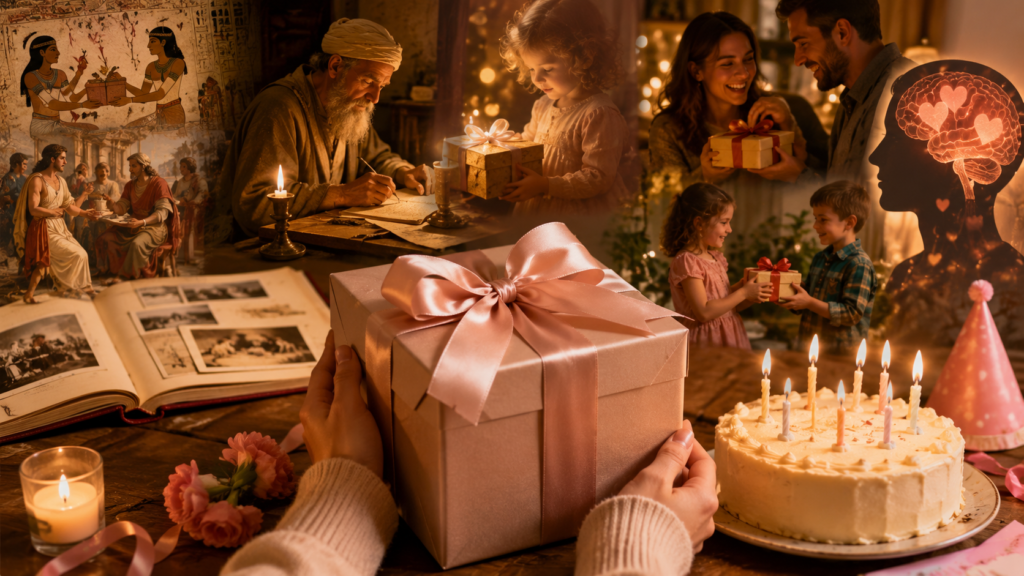
Crucially, in the ancient world, birthdays were viewed as highly dangerous transitions. It was believed that on a person’s birth anniversary, the veil between the physical and spiritual worlds thinned, making the individual highly vulnerable to malevolent spirits and curses.
The Original Intent: The earliest “birthday gifts” were not luxuries or tokens of personal affection. They were protective offerings—charms, specific foods, and communal presence—designed to ward off evil spirits and bless the individual with safety for the year ahead. Loud gatherings and well-wishes were intended to scare away lurking demons.
Ancient Protective Rituals ➔ Roman Social Innovations ➔ Victorian Commercialization
The Roman Innovation: Celebrating the Common Man
The ancient Romans shifted the paradigm. They were the first civilization to celebrate the birthdays of ordinary, non-royal men (though women’s birthdays were notably absent from public record until much later).
A Roman citizen’s 50th birthday, for example, was a major milestone celebrated with a special cake made of wheat flour, grated cheese, honey, and olive oil. During these festivities, friends and family would bring gifts, often consisting of fine oils, wines, garments, or crafted coins. Here, the meaning shifted from purely spiritual protection to social bonding and civic recognition.
The Industrial Revolution and the Democratization of Gifting
For centuries after the fall of Rome, birthday celebrations remained largely a luxury of the aristocracy. The average peasant rarely knew their exact date of birth, let alone possessed the means to celebrate it.
This changed dramatically with the Industrial Revolution in the 19th century. Mass production lowered the cost of manufactured goods, making toys, books, and clothing accessible to the emerging middle class. Simultaneously, the Victorian era ushered in a romanticized view of childhood and family life.
It was during this period that the modern birthday party was born. Gift-giving became democratic, systematized, and commercialized. The invention of mass-produced, decorative wrapping paper by the Hallmark brothers in the early 20th century added the final layer to this evolution, transforming the act of presenting a gift into a performative moment of suspense and surprise.
2. The Psychology of the Gift: What Happens in the Mind?
While history explains how the tradition spread, psychology explains why it sticks. The exchange of a birthday gift triggers a complex sequence of cognitive and emotional responses in both the giver and the receiver.
The Giver’s Brain: Altruism vs. Social Signaling
Psychological research consistently shows that spending money on others yields greater personal happiness than spending it on ourselves—a phenomenon often referred to as the “giver’s glow.” When we select and present a gift that truly resonates with someone, our brains release a cocktail of feel-good neurotransmitters:
- Dopamine: Provides a sense of pleasure and reward during the search and anticipation of giving.
- Oxytocin: Often called the “bonding hormone,” it deepens the feelings of connection between the giver and receiver.
- Serotonin: Regulates mood and fosters feelings of social pride and contentment.
However, psychology also reveals that gift-giving is rarely entirely selfless. It serves as a powerful form of social signaling. Through a gift, a giver unconsciously communicates their own taste, financial status, resourcefulness, and how highly they value the relationship. A poorly thought-out, last-minute gift signals emotional distance or neglect, while an overly extravagant gift can signal an aggressive display of wealth or a desire to dominate the dynamic.
The Receiver’s Brain: The Tensions of Reciprocity
For the receiver, opening a birthday gift is an exercise in emotional navigation. Sociologist Marcel Mauss, in his seminal 1925 essay The Gift, established that across all human cultures, gifts are never truly free. They carry three unwritten, subconscious obligations:
- The obligation to give: Initiating the social bond.
- The obligation to receive: Accepting the bond and showing gratitude.
- The obligation to reciprocate: Returning the gesture in the future to maintain equilibrium.
When someone receives a birthday gift, their brain immediately calculates where they stand on this social ledger. If a friend gives you a remarkably thoughtful, expensive birthday gift, you experience an immediate spike in affection, quickly followed by a subconscious cognitive note: “I must match this level of effort when their birthday arrives.”
The Identity Crisis of the “Bad Gift”
We have all experienced the awkward moment of opening a birthday present that completely misses the mark. From a psychological perspective, a “bad gift” causes discomfort because it creates cognitive dissonance regarding our identity.
If a close sibling gifts you a flashy, neon sports watch, but you view yourself as an understated, bookish intellectual who dislikes athletics, the gift feels like a misreading of your soul. It forces the recipient to ask: “Is this how they truly see me, or do they not know me at all?” Thus, the birthday gift acts as a mirror, reflecting how well the social circle understands the individual’s evolving identity.
3. Decoding the Deeper Meaning of Birthday Gifts
To view a birthday gift as a mere physical object is to miss its true essence. In modern sociology, gifts are understood as embodied symbols. They are physical manifestations of intangible emotions, shared histories, and future promises.
The Gift as a Language of Love
In his widely acclaimed relationship framework, Dr. Gary Chapman identifies “Receiving Gifts” as one of the five primary love languages. For individuals who speak this language, a birthday gift is not prized for its monetary value, but as a visual, tangible symbol of love and thoughtfulness.
To them, a gift means: “I thought of you when I saw this, and I wanted you to have it because I care about your happiness.” The object becomes an emotional anchor. Long after the birthday has passed, looking at that object revives the feeling of being seen, valued, and cherished.
The Unique Weight of Familial Gifting
The psychological and symbolic weight of a gift shifts dramatically depending on the dynamic of the relationship, becoming most profound within our immediate family. When we choose gifts for the people who raised us, the act moves beyond standard social etiquette and becomes a profound declaration of gratitude and recognition.
For instance, the cultural expectations and emotional nuances involved in selecting birthday gifts for dad often revolve around themes of legacy, respect, and utility, highlighting a desire to acknowledge his guidance with something lasting and meaningful. Conversely, the process of finding birthday gifts for mom frequently leans into deep sentimental value and emotional comfort, aiming to return a fraction of the unconditional warmth she has provided over a lifetime. In both scenarios, these specific family gifts act as vital bridges that strengthen the generational bonds holding a family together.
Why Do We Wrap Gifts? The Psychology of Suspense
The act of wrapping a birthday gift is a fascinating cultural phenomenon. Functionally, wrapping paper is counterproductive—it costs money, is torn apart in seconds, and is immediately discarded. Yet, it remains an essential component of the ritual.
| The Element | Cultural and Psychological Function |
| Concealment | It temporarily strips the object of its commercial identity (brand, price tag) and replaces it with a sacred status. |
| The Surprise Effect | It triggers a sudden release of dopamine in the recipient, transforming a mundane object into an exciting mystery. |
| Ritualistic Delay | The physical act of unwrapping slows down time, forcing the recipient to focus entirely on the present moment and the giver. |
4. The 21st-Century Shift: Materialism vs. Minimalism
As we navigate the mid-20th decade of the 2000s, the meaning of birthday gifts is undergoing its most significant transformation since the Industrial Revolution. Driven by shifting generational values, environmental consciousness, and the rise of minimalist lifestyles, the definition of a “valuable” birthday gift is changing.
The Rise of Experiential Gifting
Millennials and Generation Z have fundamentally redefined the gifting landscape by prioritizing experiences over material possessions.
Instead of gifting a physical gadget or an item of clothing that may eventually end up in a landfill, modern givers are increasingly opting for concert tickets, cooking classes, wellness retreats, or travel vouchers. Psychological studies support this shift, proving that experiential gifts provide more enduring happiness and create stronger social bonds than material items, because experiences become part of our identity narrative.
The Conscious Consumption Movement
In an era hyper-focused on sustainability, the traditional, mass-produced plastic knick-knack is losing its appeal. The meaningful birthday gift of today often centers around ethical sourcing, utility, and circularity.
Digital gifts—such as subscription services, audiobooks, or charitable donations made in the recipient’s name—are no longer viewed as thoughtless, last-minute options. Instead, they are increasingly recognized as deeply considerate gestures that respect both the recipient’s physical space and the planet’s boundaries.
Conclusion: The Enduring Power of the Unwrapped Emotion
Ultimately, the act of giving a birthday gift is one of humanity’s most beautiful social coping mechanisms. Life is fast, chaotic, and often alienating. Birthdays serve as an annual pause button—a moment to look at a single individual and say, “I am glad you exist, and I am glad you are in my life.”
The next time you select a birthday gift, look beyond the physical boundaries of the object and the aesthetic appeal of the wrapping paper. Recognize that you are participating in a profound, millennia-old human tradition. Whether it is a handwritten letter, a shared experience, or a carefully curated item, a birthday gift is a bridge across the emotional distance that separates us, a tangible anchor that binds our hearts, and a beautiful declaration of community in an ever-changing world.

